Choosing the right door material is an important part of planning a home. Apart from providing privacy and separating different spaces, doors contribute to the overall appearance of interiors. Their construction, finish and material quality also influence durability and maintenance requirements.
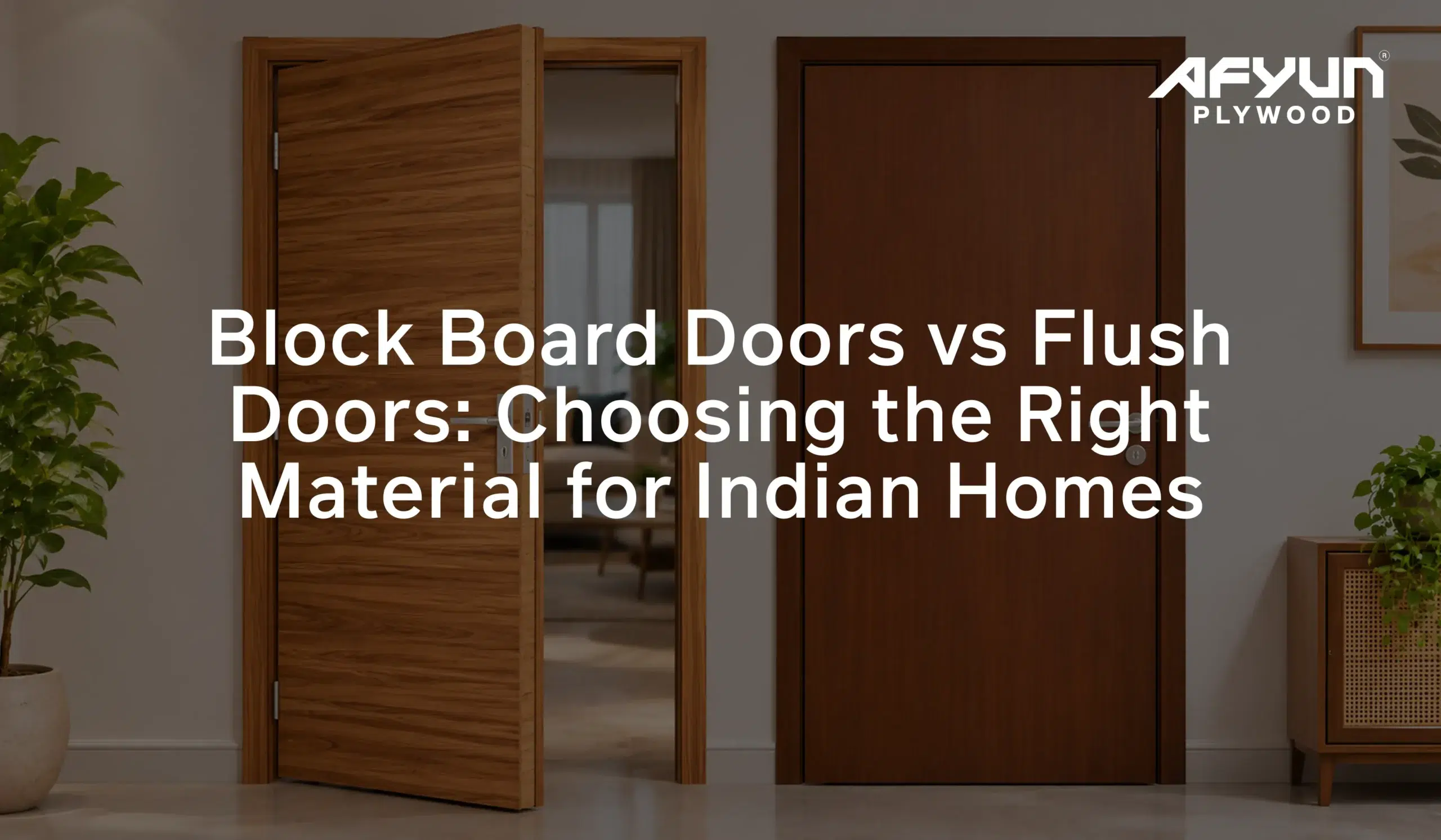
Block board doors and flush doors are two popular options for Indian homes. Both are engineered wood products, but they differ in their internal construction, weight and applications. Block board doors feature a core made of solid wooden strips, while flush doors have a flat surface with different core options, including solid and hollow constructions. Understanding these differences helps homeowners, architects and interior designers select the right material for individual rooms.
What Are Block Board Doors?
Block board is an engineered wood product manufactured using a core of solid wooden strips placed edge to edge. These strips are bonded together and covered with veneers or plywood layers on both sides.
This construction gives block board good rigidity while keeping its weight relatively manageable. It is commonly used for interior doors, furniture, partitions and other household installations.
Key characteristics of block board doors include:
- Solid timber core: Wooden strips form the central structure of the board.
- Good rigidity: The construction provides resistance to bending.
- Finishing flexibility: Decorative laminates, natural veneers and paint can be applied.
- Multiple applications: Suitable for doors, furniture and selected interior installations.
Block board doors are particularly useful in residential projects where a timber-based core and customised surface finish are preferred.
What Are Flush Doors?
Flush doors feature flat surfaces on both sides, with an internal core enclosed by facing materials such as plywood or other suitable panels. Depending on their construction, they may have solid, semi-solid or hollow cores.
Solid-core flush doors generally provide better strength and sound insulation than hollow-core alternatives. Hollow-core doors are lighter and more economical, making them suitable for applications that do not require substantial impact resistance.
Their smooth surfaces also make flush doors convenient for different decorative finishes, including laminates, veneers and paint.
Block Board Doors vs Flush Doors: What Are the Main Differences?
The primary difference between block board and flush doors lies in their internal construction. This affects their weight, rigidity, applications and overall performance.
| Feature | Block board doors | Flush doors |
| Core construction | Solid wooden strips | Solid, semi-solid or hollow core |
| Surface | Veneer or plywood facing | Flat facing material |
| Weight | Generally manageable | Depends on core construction |
| Rigidity | Good resistance to bending | Depends on core type |
| Finishing | Laminates, veneers and paint | Laminates, veneers and paint |
| Common applications | Doors, furniture and partitions | Bedrooms, living rooms and offices |
| Cost | Depends on grade and finish | Depends on core and finish |
1. Which Offers Better Strength and Durability?
Block board doors offer good rigidity because of their timber-based core. They are suitable for applications where resistance to bending is important.
Solid-core flush doors can also provide considerable strength and impact resistance. However, the actual performance of either option depends on:
- Quality of the raw materials.
- Adhesive bonding and manufacturing process.
- Core construction and density.
- Thickness and dimensions.
- Installation and maintenance.
Neither material should be considered automatically superior without examining its grade and intended application.
2. Which Is Lighter and Easier to Install?
Hollow-core flush doors are usually lighter than solid-core alternatives. Block board doors are also relatively manageable in weight, although their final weight depends on dimensions and construction.
Door weight should be considered when selecting hinges, frames and other hardware. Proper installation is essential to prevent sagging and alignment problems.
3. Which Offers Better Design Flexibility?
Both materials support different decorative finishes.
Block board doors can feature:
- Natural wood veneers.
- Decorative laminates.
- Painted finishes.
- Grooves and panel detailing.
Flush doors are particularly suitable for minimalist interiors because of their smooth and uniform surfaces. Textured laminates and painted finishes can complement contemporary residential designs.
Which Door Is Better for Different Rooms in Indian Homes?
The intended application should guide the choice between block board and flush doors.
| Room or application | Suitable considerations |
| Bedroom | Block board or solid-core flush doors |
| Living room | Both, depending on design preferences |
| Bathroom | Moisture-resistant specifications and sealed edges |
| Kitchen | Moisture exposure and surface protection |
| Study room | Both, with attention to sound insulation |
| Commercial interiors | Strength, durability and applicable safety standards |
Bathrooms and kitchens require additional consideration because of moisture exposure. Neither ordinary block board nor standard flush doors should be treated as waterproof. Moisture-resistant specifications, suitable surface finishes and properly sealed edges are important.
What Should You Know About Fire Safety When Selecting Plywood?
Door selection is not limited to appearance and everyday durability. Fire safety is another important consideration, particularly in multi-storey residential buildings, commercial interiors and spaces with specific building safety requirements.
Plywood and engineered wood products are available in different grades and specifications. Standard plywood does not automatically provide enhanced fire resistance.
For projects that require improved fire performance, fireman fire retardant plywood is a material option worth considering. Fire-retardant plywood is specially manufactured and tested to meet specified fire-performance requirements. Its purpose is to reduce flame spread under defined testing conditions, rather than make the material completely fireproof.
Before selecting fire-retardant plywood, buyers should examine:
- Relevant fire-performance standards.
- Manufacturer’s test reports.
- Product certifications.
- Intended application and installation requirements.
- Compliance with applicable building regulations.
It is important to distinguish fire-retardant properties from complete fireproofing. The material should be selected according to the actual safety requirements of the project.
What Are the Standard Block Board Door Thicknesses and Sizes?
Door dimensions influence both appearance and functionality. Block board door thickness varies according to the intended application and manufacturer specifications. Common options include 25 mm, 30 mm and 35 mm, although other thicknesses may be available.
Similarly, block board door sizes should correspond to the door frame and opening dimensions. Standard residential sizes are commonly available, while custom dimensions may be required for particular architectural layouts.
A block board door design can incorporate:
- Natural wood textures.
- Decorative laminates.
- Grooves and panel detailing.
- Painted finishes.
- Contemporary geometric patterns.
The final cost depends on several factors, including dimensions, thickness, surface finish and manufacturing quality.
When comparing the block board Door price per sq ft, buyers should check whether the quotation includes finishing, hardware and installation. A block board door price may vary between manufacturers and suppliers, so comparing product specifications alongside quotations is important.
Can Block Board Be Used for Wardrobes and Other Furniture?
Yes. Block board is not restricted to door manufacturing. It can also be used for selected furniture and interior applications where its construction is suitable.
A block board wardrobe is one possible application, particularly when a project requires rigid panels and coordinated finishes.
Other applications include:
- Interior partitions.
- Shelving and storage units.
- Selected furniture components.
- Study tables and cabinets.
- Decorative interior installations.
The appropriate grade and thickness should be selected according to the expected load, dimensions and exposure to environmental conditions.
How Do You Choose the Right Material for Your Home?
There is no universal winner in the comparison between block board and flush doors. Both have applications in residential interiors, and their suitability depends on construction quality, room conditions and budget.
Before purchasing, consider:
- Application: Identify whether the door is intended for a bedroom, bathroom, kitchen or commercial space.
- Core construction: Compare the internal structure and material grade.
- Dimensions: Select appropriate thickness and size.
- Moisture exposure: Consider suitable grades, finishes and edge protection.
- Design: Choose laminates, veneers or paint that complement the interiors.
- Budget: Compare specifications and overall installation costs.
Working with experienced plywood suppliers in India can help homeowners identify suitable materials and compare product specifications before making a purchase.
Explore Plywood Solutions with Afyun Plywoods
The quality of materials used in a home has a direct bearing on the performance of its interiors. Afyun Plywoods offers plywood solutions for construction and interior applications, including specialised requirements where product specifications and quality standards are important.
Whether you are planning residential interiors or sourcing materials for a larger project, connect with Afyun Plywoods to discuss your requirements and explore suitable plywood solutions.
Frequently Asked Questions
1. Which is better for Indian homes, block board or flush doors?
Both are suitable for residential interiors. Block board has a solid wooden-strip core, while flush doors are available in different core constructions. The choice depends on the room, budget and intended use.
2. Are block board doors durable?
Yes. Quality block board doors can offer good durability and rigidity when manufactured with suitable timber, adhesives and facing materials.
3. What is the usual thickness of a block board door?
Common thickness options include 25 mm, 30 mm and 35 mm. The appropriate option depends on the door’s application and manufacturer specifications.
4. Are flush doors suitable for bathrooms?
Moisture-resistant flush doors may be suitable when properly finished and installed. Ordinary flush doors should not be considered waterproof.
5. Can block board be used for wardrobes?
Yes. Block board can be used for wardrobes, shelves and selected furniture components, provided the grade and thickness are appropriate.
6. What determines the price of a block board door?
Core quality, thickness, dimensions, surface finish, adhesive quality and manufacturing standards influence the price.
7. Can block board doors be laminated?
Yes. They can be finished with decorative laminates, natural veneers and suitable paints.
8. Is fire-retardant plywood the same as regular plywood?
No. Fire-retardant plywood is specially manufactured and tested to meet specified fire-performance requirements. Regular plywood does not automatically offer these properties.
9. What should I check when buying plywood?
Check the grade, thickness, bonding quality, certifications and suitability for the intended application.
10. Where can I source plywood for residential projects?
Afyun Plywoods can help buyers explore plywood solutions for different construction and interior requirements. Contact the team for product information and assistance.
Plywood Suppliers in Kerala | Plywood Suppliers in Bangalore | Plywood Suppliers in Chennai | Plywood Suppliers in Hyderabad |Plywood Manufacturers in Mangalore | Plywood Manufacturers in Coimbatore | Plywood Manufacturers in Tamilnadu | Plywood Manufacturers in Mysore | plywood manufacturers in india | Plywood Manufacturers in Kerala | Plywood Manufacturers in Bangalore | Plywood Manufacturers in Chennai | Plywood Manufacturers in Hyderabad