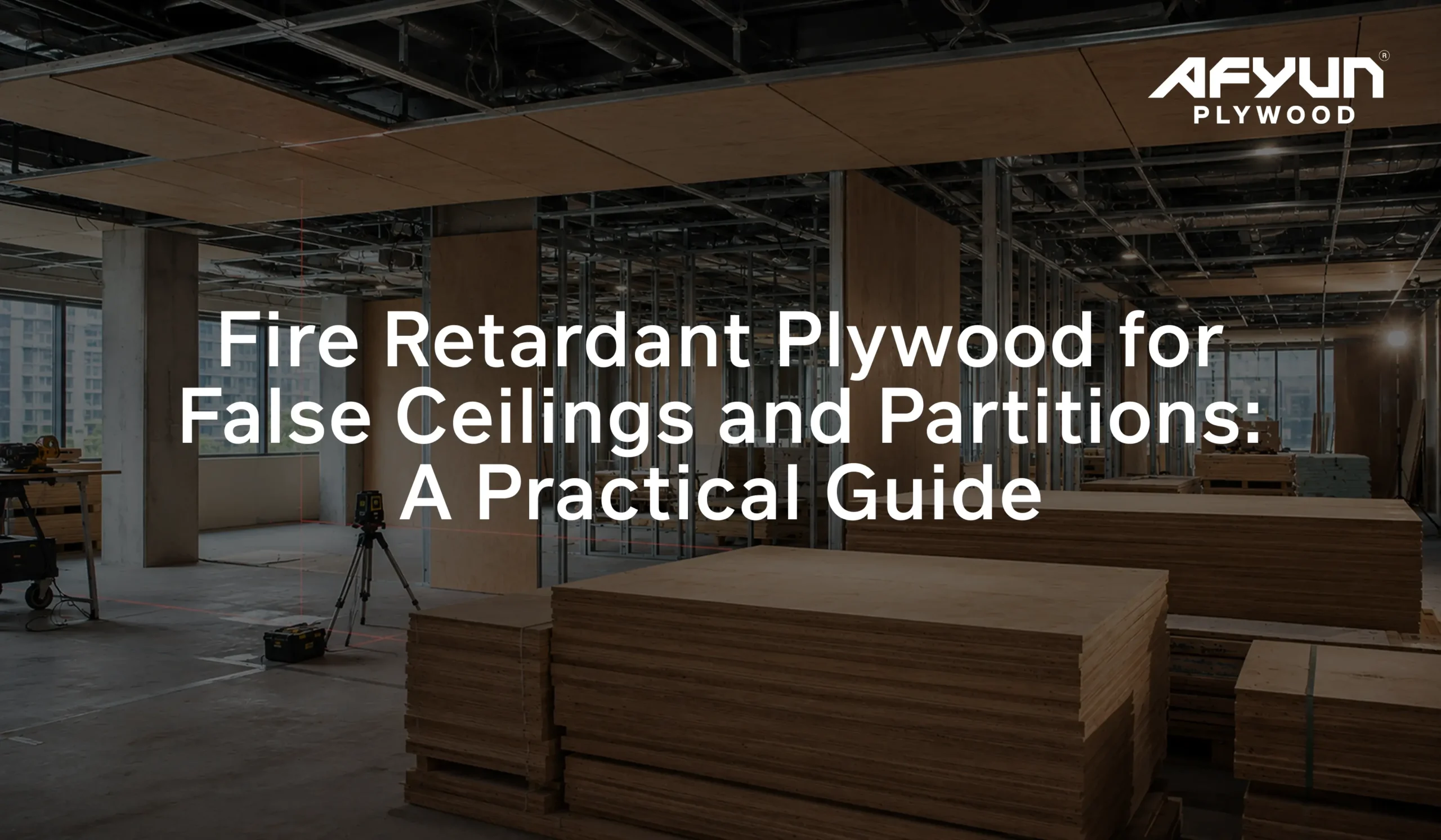
False ceilings and partitions are some of the most common interior elements in hospitality, com
mercial, and residential projects across the Gulf. They also happen to be among the highest fire risk zones in any building, since they conceal wiring, ductwork, and structural gaps where flames can spread unseen. Choosing the right plywood for these applications is not just a design decision, it is a life safety decision.
What Makes Plywood Fire Retardant?
Fire retardant plywood is timber panel product treated with chemical compounds that slow down flame spread and reduce smoke generation when exposed to fire. The treatment does not make the plywood fireproof, but it significantly delays combustion and gives occupants more time to evacuate.
This is achieved through impregnation with fire retardant salts during manufacturing, which interrupt the chemical reactions that sustain fire. The treated core is then bonded with phenolic resin adhesives that also contribute to heat resistance.
Fire Retardant Plywood vs Standard Plywood
| Feature | Standard Plywood | Fire Retardant Plywood |
| Flame spread | Ignites quickly, spreads fast | Chars slowly, delays flame spread |
| Smoke generation | High, more toxic in enclosed spaces | Reduced smoke output |
| Core treatment | None | Impregnated with fire retardant salts |
| Adhesive used | Often urea formaldehyde | Typically phenolic resin |
| Code compliance | Not accepted for false ceilings or fire barrier partitions | Meets ASTM E84, IS 5509, SASO or SABER where required |
| Cost | Lower upfront cost | Slightly higher, offset by compliance and safety value |
Why Are False Ceilings and Partitions High Risk Areas?
False ceilings and partitions create concealed cavities that act like chimneys during a fire, pulling flames and smoke rapidly across a building. Many major fire incidents in hotels, malls, and offices have started or spread through these hidden voids.
- Concealed cavities let flames spread quickly and invisibly
- Electrical wiring and HVAC ducting run through these spaces
- Partitions often double as fire barriers along escape routes
- UAE and Saudi building codes mandate fire rated materials in these zones specifically
This is exactly why building codes in the UAE and Saudi Arabia mandate fire rated materials for these specific applications, rather than leaving it to contractor discretion.
What Fire Ratings Should You Look For?
The most relevant fire performance indicators for plywood are Flame Spread Index, Smoke Developed Index, and compliance with ASTM E84 testing standards. Lower FSI and SDI values indicate better fire performance, with Class A rated products offering the highest level of protection suitable for false ceilings and partitions.
- Flame Spread Index (FSI), lower value means better performance
- Smoke Developed Index (SDI), critical for enclosed false ceiling cavities
- ASTM E84 compliance for international projects
- IS 5509 certification for Indian manufactured plywood
- SASO or SABER certification for Saudi Arabia customs and project approval
Here is the data from the image organized into a clean table format:
Certification Requirements by Region
| Region | Standard Required | What It Covers |
| India | IS 5509 | Testing and classification of fire retardant plywood |
| UAE and Saudi Arabia (international projects) | ASTM E84 | Flame spread and smoke developed index |
| Saudi Arabia (customs and project approval) | SASO or SABER | Certification for import and building code compliance |
Architects and consultants specifying materials for hospitality projects should always request test certificates rather than relying on verbal assurances from suppliers.
How Does Fire Retardant Plywood Perform in Real Fire Conditions?
Fire retardant plywood chars slowly on the surface rather than igniting into open flame, which limits fire spread and reduces smoke toxicity in enclosed spaces. This char layer acts as an insulating barrier that protects the inner layers of the panel for a longer duration compared to untreated wood.
In false ceiling applications, this translates to more time before structural collapse or flame breakthrough into adjacent rooms. In partitions, it means the wall itself does not become fuel for the fire, which is critical in corridors used as escape routes.
Fireman Fire Retardant Plywood: A Reliable Choice for Demanding Projects
For hospitality and commercial projects where fire compliance cannot be compromised, fireman fire retardant plywood is engineered specifically for these high-risk zones. It is manufactured with a treated core designed to meet stringent flame spread and smoke development benchmarks required in UAE and Saudi projects.
- Engineered for high risk zones like false ceilings and partitions
- Meets flame spread and smoke development benchmarks for UAE and Saudi projects
- Structurally stable under Gulf humidity and temperature swings
- Suited for hospitality corridors, staircases, and high occupancy areas
Contractors also prefer it for partitions in hospital corridors and staircases, where fire barriers are non-negotiable under local codes. Beyond compliance, this plywood also holds up well structurally under humidity and temperature swings common in Gulf construction environments, so it does not warp or delaminate over time like lower grade alternatives.
What Should Architects and Contractors Check Before Specifying?
Before finalizing plywood for false ceilings or partitions, always verify the fire test certificate, resin type, and core composition against project specifications.
- Fire test certificates (ASTM E84 or IS 5509)
- Resin type, phenolic bonded panels perform better under heat
- Core composition and consistency across batches
- Moisture resistance, especially for humid or coastal sites
- SASO or SABER documentation for smooth customs clearance
- Sample panel or burn test demonstration for large projects
Signs you’re being sold non compliant plywood
- No test certificate offered, or only a verbal assurance
- Certificate does not match the specific product batch
- Supplier cannot explain FSI or SDI values for their product
- No SASO or SABER documentation for Saudi bound shipments
- Panel has no visible fire rating stamp or label
Does Fire Retardant Plywood Cost More, and Is It Worth It?
Fire retardant plywood typically costs more than standard plywood due to the treatment process and testing certifications involved. However, the cost difference is marginal compared to the total interior fit out budget, and it is negligible compared to the liability and safety risk of using non compliant material.
- Price difference versus standard plywood is marginal against total fit out cost
- Non compliance risk and liability far outweigh the price gap
- Insurance and occupancy certificates increasingly require documented fire compliance
How Do You Choose the Right Supplier?
Not all plywood labeled as fire retardant meets the same testing standards, so sourcing from established plywood manufacturers in India with export experience to the Gulf region matters. Indian manufacturers have long supplied fire rated plywood to UAE and Saudi markets, largely because of strong technical compliance with both IS 5509 and international ASTM benchmarks.
Look for manufacturers who can provide full documentation, consistent batch quality, and export logistics support, since delays in customs clearance due to missing SASO or SABER paperwork can stall entire projects.
Final Thoughts
Fire retardant plywood for false ceilings and partitions is not a specification detail to treat lightly. It directly affects occupant safety, code compliance, and long term project liability, especially in high occupancy hospitality and commercial builds across the UAE and Saudi Arabia.
Afyun Playwoods manufactures fire retardant plywood engineered for exactly these applications, tested to ASTM E84 and IS 5509 standards, and backed by full SASO and SABER documentation for Gulf projects. If you are sourcing fire rated plywood for an upcoming false ceiling or partition project, reach out to Afyun Playwoods for product specifications and sample panels suited to your build.
1. What is fire retardant plywood?
Fire retardant plywood is timber panel treated with chemical compounds that slow flame spread and reduce smoke generation during a fire.
2. Is fire retardant plywood completely fireproof?
No. It does not prevent burning entirely, but it significantly delays ignition and flame spread, giving occupants more time to evacuate.
3. Why is fire retardant plywood important for false ceilings?
False ceilings conceal wiring and ducting in a hidden cavity that can spread fire rapidly if untreated plywood is used. Fire retardant plywood limits this risk.
4. What certifications should I check before buying?
Look for ASTM E84 compliance, IS 5509 certification for Indian made plywood, and SASO or SABER documentation for Saudi Arabia projects.
5. What is the difference between FSI and SDI?
FSI, or Flame Spread Index, measures how quickly fire spreads across a surface. SDI, or Smoke Developed Index, measures how much smoke is produced. Lower values are better for both.
6. Does fire retardant plywood cost significantly more than regular plywood?
The price difference is usually marginal compared to the overall interior fit out budget, and it is far lower than the cost of non compliance or fire damage.
7. Is fire retardant plywood mandatory under UAE and Saudi building codes?
Yes, for false ceilings, partitions, and fire escape routes in most commercial and hospitality projects, fire rated materials are required by local building codes.
8. What is fireman fire retardant plywood used for?
Fireman fire retardant plywood is designed for high risk zones like false ceilings, partitions, and hospital corridors, meeting strict flame spread and smoke standards for Gulf projects.
9. How do I verify a supplier’s fire retardant plywood is genuine?
Ask for a test certificate matching the specific product batch, along with SASO or SABER documentation for Saudi bound shipments. Avoid suppliers who only give verbal assurances.
10. Why source from established plywood manufacturers in India?
Indian manufacturers have long experience exporting fire rated plywood to Gulf markets and typically offer strong compliance with both IS 5509 and international ASTM standards.