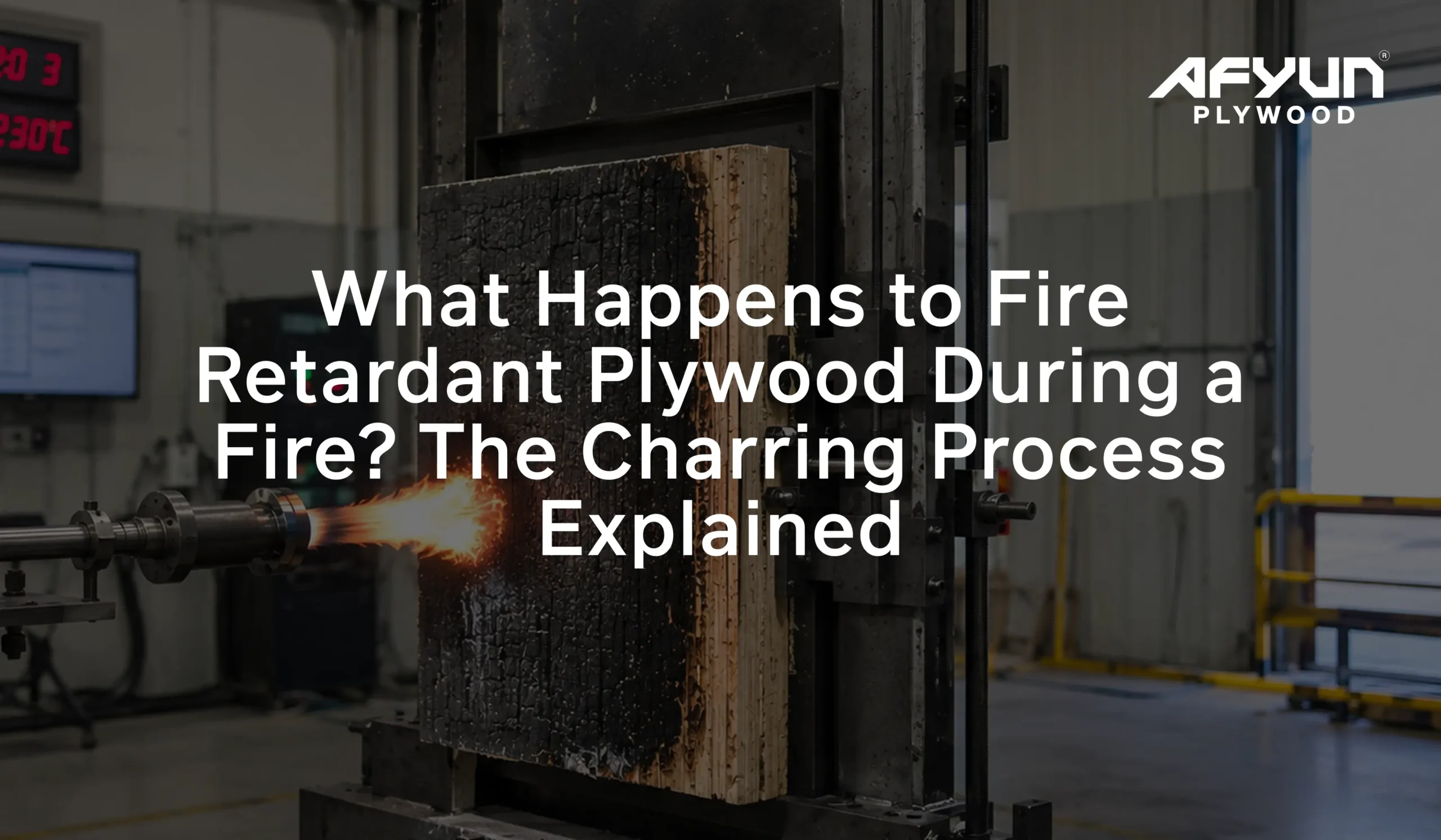
“Fire retardant” is one of those terms used so often in construction specifications that its actual mechanism gets lost. It does not mean the plywood refuses to burn. It means the plywood burns differently, slower, cooler, and in a way engineered to buy critical time during a fire. Understanding exactly what happens inside the wood during combustion is essential for architects, contractors, and buyers who need to specify materials correctly rather than simply trusting a label.
What Makes Plywood Fire-Retardant?
Plywood becomes fire-retardant through a chemical treatment process that alters how the wood reacts to heat, typically by promoting char formation, releasing water vapor, and slowing the release of flammable gases during combustion.
Untreated plywood, when exposed to fire, breaks down quickly into flammable volatile gases that feed the flame and accelerate spread. Fire retardant chemicals interrupt this process at a molecular level.
The core chemical mechanisms behind fire retardancy include:
- Char-promoting compounds: encourage the wood surface to form a protective carbon layer rather than combust freely
- Water-releasing agents: certain treatments release bound water vapor when heated, cooling the surface and diluting flammable gases
- Gas-phase inhibitors: interfere with the chemical reactions that sustain flame once ignition begins
- Phosphorus and nitrogen-based compounds: commonly used in impregnation treatments to catalyze char formation over flaming combustion
These treatments are typically introduced through pressure impregnation, forcing the chemical solution deep into the wood fibers rather than leaving it as a surface coating that can wear away over time.
What Actually Happens When Fire Retardant Plywood Burns?
When fire retardant plywood is exposed to flame, the treatment triggers accelerated char formation on the surface, creating an insulating carbon layer that slows heat penetration and delays the spread of fire into the remaining wood structure.
The Charring Process, Step by Step
The charring sequence happens in a fairly predictable order, and understanding each stage explains why treated plywood performs so differently from untreated material.
- Initial heat exposure: surface temperature rises, and fire retardant compounds begin reacting before the wood itself would normally ignite
- Dehydration and water release: bound moisture and chemically released water vapor cool the immediate surface and reduce flammable gas concentration
- Char layer formation: instead of releasing large volumes of flammable gas, the surface converts into a carbon char layer
- Insulation effect: the char layer, which is a poor conductor of heat, slows further heat transfer into the unburned wood beneath it
- Reduced flame spread: with less flammable gas being released and heat penetration slowed, flame spread across the panel surface is significantly reduced compared to untreated plywood
Why the Char Layer Matters So Much
The char layer is not simply leftover damage. It is functionally protective. Once formed, it acts as a barrier between the flame and the wood underneath, similar to how a burnt log’s outer layer can protect its unburned core from further ignition. This is the entire principle fire retardant treatment is built around: encourage controlled charring early, rather than allowing rapid, uncontrolled combustion.
Does Fire-Retardant Wood Burn?
Yes, fire-retardant wood does burn, but it burns significantly slower, with reduced flame spread and lower smoke density compared to untreated wood, which provides critical additional time for evacuation and fire response.
This is the most common misconception buyers have about fire retardant plywood. No wood-based product, regardless of treatment, becomes entirely non-combustible under sustained, high-intensity fire exposure. What changes is the rate and behavior of combustion.
Key differences between treated and untreated wood combustion:
| Factor | Untreated Plywood | Fire Retardant Plywood |
| Ignition time | Fast | Delayed |
| Flame spread rate | Rapid | Significantly slowed |
| Smoke density | Higher | Reduced |
| Char formation | Minimal, uncontrolled | Rapid, protective char layer |
| Structural integrity during fire | Degrades quickly | Retained longer due to insulating char |
Is Charred Wood Fire-Resistant?
Charred wood is more fire-resistant than raw, untreated wood because the char layer itself is difficult to ignite further and acts as an insulating barrier, though it is not entirely immune to continued fire damage under prolonged, intense exposure.
This is why fire retardant treatments are specifically engineered to accelerate and stabilize char formation rather than prevent it. The char is not the failure point, it is the protective mechanism.
Why char behaves this way:
- Char is largely carbon, which requires much higher temperatures to combust further than the original wood
- The char layer has low thermal conductivity, slowing heat transfer to unburned material beneath it
- A stable char layer reduces oxygen exposure to the wood underneath, further limiting combustion
Does Fire-Retardant Material Burn Differently Depending on Treatment Quality?
Yes, the effectiveness of fire retardant material depends heavily on treatment quality and depth of chemical penetration, which is why pressure-impregnated treatments consistently outperform surface-applied coatings in real fire conditions.
A surface coating can be scratched, worn, or simply fail to penetrate deep enough to protect the core of the panel. Pressure-treated products, where the fire retardant chemistry penetrates through the wood fibers rather than sitting on top, tend to maintain protective performance more consistently, even under sustained heat exposure.
This distinction matters enormously in real-world specification. Products like fireman fire retardant plywood, engineered for deep chemical impregnation rather than surface treatment, are built specifically to maintain char-forming performance throughout the panel rather than only at the surface, which is a critical difference in how the material behaves once a fire actually reaches it.
How Is Fire Retardant Performance Measured and Certified?
Fire retardant performance is typically measured through standardized fire testing that evaluates flame spread rate, smoke density, and char depth under controlled combustion conditions, with certification confirming the product meets recognized fire safety benchmarks.
What buyers and specifiers should generally verify:
- Compliance with relevant fire performance testing standards for the region of use
- Documentation confirming the treatment method, pressure-impregnated versus surface-applied
- Consistency of treatment across production batches, not just a single tested sample
- Manufacturer transparency around chemical composition and treatment process
Reputable manufacturers should be able to provide test documentation and certification details on request rather than relying solely on marketing claims. If a project’s fire compliance depends on this material, that documentation is not optional paperwork, it is the evidence the specification is actually being met.
Where Is Fire Retardant Plywood Typically Used?
Fire retardant plywood is most commonly specified in buildings and applications where fire safety compliance is mandatory or where occupant safety during evacuation is a critical design consideration.
Common use cases include:
- Commercial interiors and office partitioning
- Hotels, hospitals, and other high-occupancy public buildings
- Educational institutions and auditoriums
- Ceiling panelling and wall linings in regulated commercial spaces
- Retail fit-outs in malls and large public venues
Why Manufacturing Quality Determines Real-World Performance
Everything described above, char formation, gas suppression, insulation, depends entirely on consistent, correctly executed chemical treatment during manufacturing. A well-designed fire retardant formula applied inconsistently across a production batch will not perform as tested. This is why sourcing from established plywood manufacturers in India with rigorous quality control and standardized pressure-impregnation processes matters as much as the treatment chemistry itself. The lab result on a data sheet only means something if every panel leaving the factory actually reflects it.
The Bottom Line on Fire Retardant Charring
Fire retardant plywood does not stop fire. It changes how fire behaves, slowing ignition, promoting a protective char layer, reducing smoke, and buying time that can be the difference between safe evacuation and disaster. Understanding this mechanism, rather than treating “fire retardant” as a vague safety label, is what allows architects, contractors, and buyers to specify the right product with real confidence in how it will perform.
Source Certified Fire Retardant Plywood From Afyun Plywoods
Afyun Plywoods manufactures fire retardant plywood engineered for deep, consistent chemical penetration and dependable char-forming performance under real fire conditions. Backed by standardized production processes built for commercial and export markets, Afyun’s fire retardant range is designed to perform exactly as specified, panel after panel.
Get in touch with Afyun Plywoods today to request technical documentation and certification details for your project’s fire retardant plywood requirements.
FAQs
1. What makes plywood fire-retardant?
Fire-retardant plywood is treated with specialised fire-resistant chemicals that slow flame spread, reduce heat release and encourage the formation of a protective char layer during a fire. This treatment improves fire performance without compromising the plywood’s structural strength.
2. Does fire-retardant plywood catch fire?
Yes. Fire-retardant plywood can catch fire, but it ignites much more slowly than ordinary plywood. Its chemical treatment delays combustion and limits the speed at which flames spread across the surface.
3. How does the charring process protect plywood?
When exposed to high temperatures, the outer layer of fire-retardant plywood forms a carbon-rich char. This char acts as an insulating barrier, reducing heat transfer to the inner layers and slowing further burning.
4. Is fire-retardant plywood the same as fireproof plywood?
No. Fire-retardant plywood is not fireproof. It is designed to slow the spread of fire and improve evacuation time by resisting rapid combustion, but it will eventually burn under prolonged fire exposure.
5. Where is fire-retardant plywood commonly used?
Fire-retardant plywood is widely used in hotels, hospitals, schools, airports, shopping malls, office buildings, theatres, public infrastructure, commercial kitchens and other buildings where enhanced fire safety is required.
6. Which certifications should I look for when buying fire-retardant plywood?
Look for recognised certifications such as ASTM E84, EN 13501, IS 5509, CARB certification and relevant Civil Defence approvals, depending on your project’s location and regulatory requirements.
7. Does fire-retardant plywood produce less smoke?
Yes. High-quality fire-retardant plywood is designed to reduce smoke generation compared to untreated plywood, helping improve visibility and safety during a fire emergency.
8. Can fire-retardant plywood be used for furniture and interiors?
Absolutely. It is commonly used for wall panelling, partitions, cabinetry, furniture, ceilings, display units and other interior applications where both aesthetics and fire safety are important.
9. Does fire-retardant treatment affect the strength of plywood?
No. When manufactured correctly, fire-retardant treatment does not significantly affect the plywood’s structural performance. Premium products retain excellent strength, dimensional stability and screw-holding capacity.
10. Why choose Afyun Plywood for fire-retardant applications?
Afyun Plywood offers high-quality fire-retardant plywood manufactured to stringent quality standards and tested against recognised fire safety benchmarks. Its products combine durability, consistent performance and certified fire resistance, making them suitable for commercial, institutional and residential projects.